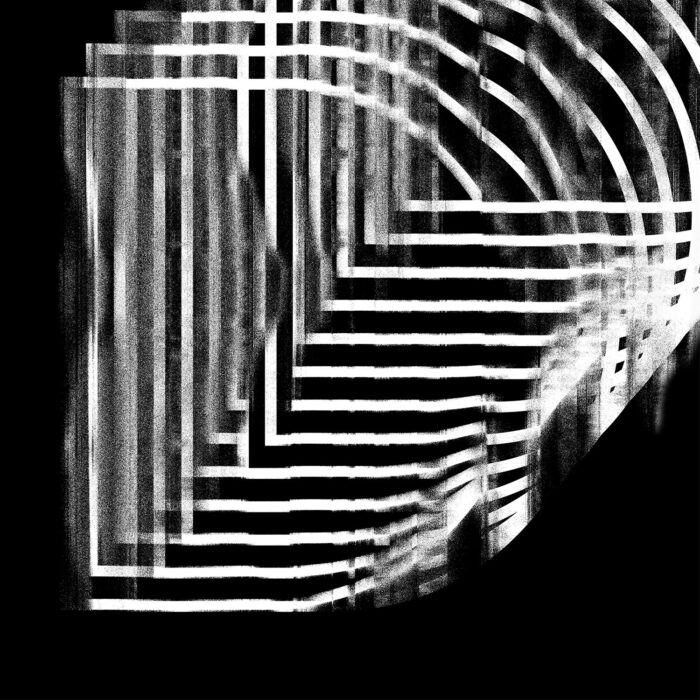
Debut albums are usually eager things. They try to explain themselves, justify their existence, maybe even win you over. “Displacements” doesn’t bother. It behaves more like a system already in motion before you arrived, and frankly, it’s not going to stop just because you pressed play.
Jorge Solís Arenazas comes to this first full-length release not as a newcomer, but as someone who has already spent years circling the problem of sound from multiple angles: composition, writing, radio, installation. You can hear that background immediately. This is not “music” in the conventional sense. It’s closer to a set of conditions under which listening becomes unstable, slightly unreliable, occasionally even suspicious of itself.
The conceptual backbone is almost annoyingly rigorous. Language, chaos, discrete systems, the way structure emerges from accident. All the things that make normal people slowly back away from the room. Yet what’s interesting is how little of that theory feels imposed. Instead, it seeps into the material, shaping it from within rather than sitting on top like a polite academic hat.
The album is organized as a kind of vertical journey, which sounds grand until you realize it mostly involves frequencies doing things your ears aren’t entirely comfortable with. “Anabasis I” opens in the upper register, built from feedback systems that feel less like instruments and more like negotiations. High frequencies flicker, stretch, threaten to disappear. It’s not aggressive, but it is insistent, like a mosquito that studied philosophy.
Then comes “Catabasis”, the descent. Brownian noise, low-end rumble, a slow gravitational pull into density. If the first piece destabilizes your sense of orientation, this one removes the ground altogether. There’s a peculiar beauty in how it accumulates weight without ever becoming static. It breathes, but heavily, like something that has learned respiration from a manual written in another language.
“Eschatia” sits in between, and predictably refuses to behave like a simple midpoint. It feels more like a border crossing where nobody checks your documents but everything still feels vaguely illicit. Synth layers drift in and out, residues of rhythm appear and dissolve, and for a brief moment you might think you’ve found something resembling form. That illusion doesn’t last. It was never meant to.
By the time “Anabasis II” arrives, the ascent has changed character. It’s not a repetition but a memory of the first movement, altered by everything that happened in between. The feedback is more fractured, less innocent. If the opening suggested exploration, this closing section feels like returning to a place that no longer exists in the same way.
What makes “Displacements” quietly compelling is its refusal to dramatize any of this. There are no climaxes, no gestures designed to reassure you that something “important” just happened. Instead, the album trusts accumulation, micro-variation, the slow imprint of sound on memory. It’s almost irritatingly patient. You keep waiting for a revelation, and it keeps offering you… process.
Which, to be fair, is the point.
The mastering by Rafael Anton Irisarri deserves a brief, reluctant nod. There’s a clarity here that prevents the material from collapsing into indistinct noise. Every frequency band feels intentional, even when it’s actively resisting your attempt to make sense of it.
Released on LINE, a label that has built an entire aesthetic out of restraint and microscopic attention, “Displacements” fits almost too well. It shares that familiar LINE quality of being simultaneously precise and elusive, like a diagram that keeps erasing itself while you study it.
There’s also something unexpectedly human beneath all this abstraction. The dedication to his brother, the long gestation of the material, the years of thinking and rethinking these structures. For all its talk of systems and randomness, the album is ultimately about attention. About how we listen, how we remember, how we impose meaning on things that don’t particularly care whether we understand them.
Not exactly background music. More like foreground uncertainty.
You won’t come out of it with answers. But you might start noticing how fragile your questions were to begin with, which is either enlightening or deeply inconvenient, depending on your tolerance for ambiguity.
—chaindlk.com
EXCERPT: Displacements reflects a profound, ambivalent phenomenon – or riddle – of a pendular motion, a continuous displacement between two contrasting but apparently complementary poles, and of quite familiar feelings. On one hand, there is the notion of uncertainty and vulnerability in the face of uncontrollable events; on the other, the sense of apparent stability that arises when deeper structures of listening and memory come to the surface—structures that are strictly speaking cultural markers, both material and symbolic prints. These deeper structures of listening and memory extend beyond any personal sphere, even if we encounter them only through personal choices.
With this intriguing work, Arenazas questions whether these deeper structures are fundamentally comparable to fleeting accidents in the sense that they, too, escape our control. This work corresponds with Arenazas’ recent work, Leviathan, inspired by the 17th-century book by the English philosopher Thomas Hobbes. Arenazas suggests on Leviathan geometric sonic ecosystems that embrace Hobbes ideas about the inner tension with language, exposing certain dynamics of domination and, at the same time, of opposition and resistance, the real or its mystification, the truth and error.
—percorsimusicali.eu