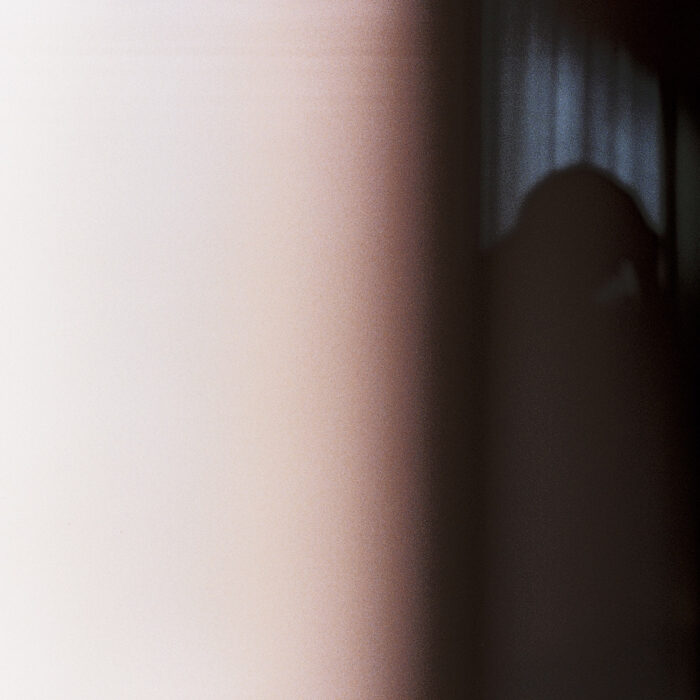
RELEASE DATE: March 13, 2026 on all digital listening platforms
Chroma: the pure shimmer of appearance that never settles into a thing. Leonie Strecker’s debut album takes this as its guiding figure, unfolding five compositions devoted to wavering states of sound, to layering and veiling, to emergence and disappearance, to the slow shifting of what is heard and what is almost heard. Again and again, the music moves along fault lines between abstraction and materiality, between synthetic construction and fragile presence, between stasis and barely perceptible transformation. What is at stake throughout is not simply sound as an object, but sound as something that blurs, is reinterpreted, covered over, or recalled like a memory, never entirely fixed, never entirely gone.
The opening piece, chroma accuracy, functions as a kind of compressed prelude. It presents, in a densified form, much of the material that will be unfolded over the course of the album: the synthetic organ sounds, their ambiguous spatiality, the oscillating, layered rhythms, and the clearly articulated formal design. As a concentrated anticipation of the final title track, it already establishes the album’s central tension between clarity and saturation, between structural precision and perceptual uncertainty.
The second track, a tear in my eye, forms a sharp timbral contrast to the surrounding organ-based pieces. It is brief, minute, and intensely focused, a contraction of the dynamic that runs through the entire album. Moving continually between silence, a high pitch, and turbulent, chaotic noise, it stages a kind of sonic flickering, a restless oscillation passing through the fundamental thresholds of sound itself. Toward the end, this texture is met by a short, guttural vocal fragment. This gesture “intimates” in both senses of the word: it hints at something other, something just barely present, and at the same time suggests an inwardness, a bodily or subjective depth that shows itself only indirectly. In this short piece, sonic abstraction is suddenly yet liminally grazed by a fleeting trace of corporeal presence.
The third composition, peripher, can be heard as a gradual transformation of modes of listening. Its beginning stands in stark contrast to the synthetic material, a recording clearly tied to a physical source. Then the organ appears, not only as an instrument, but as a curious threshold object, already a kind of abstraction of timbre, already halfway between breath, mechanism, and synthesis. Underblown tones drift in tuning. Air noises and unstable partials come to the foreground. Gradually, this fragile materiality is drawn into a process of abstraction, until it merges almost imperceptibly with the synthetic organ sounds that form the album’s core sound world.
At the heart of the album lies a subtle and highly sensitive exploration of sonic layering: of interferences, beatings, and spectral phenomena that emerge when sounds encounter and partially obscure one another. Throughout, the music stages something fundamental to aesthetic perception itself: the becoming of appearance, the coming-into-being of a phenomenon before it fully stabilizes into an object. What we hear is often neither fully present nor fully absent, but something like a sonic veil, a spectral state that hovers between emergence and dissolution.
This is perhaps most tangible in MONO. The piece begins with noise that at first seems like mere background, but gradually starts to form a space, a depth, and then to take on the rhythmic oscillation that runs through the entire album. Out of this immersive field, a voice begins to appear and disappear, first only as a trace, as consonantal fragments, as a kind of residue of speech. MONO is a fixed-media version of a performative piece in which Leonie Strecker reads a text while her voice emerges and is then slowly submerged in noise. In its acousmatic form, what remains is not so much speech as such, but the sticking-out of articulation: the fragile emergence and dissolution of vocal and linguistic identity itself.
The album’s guiding concept, chroma, names precisely this unstable zone. In classical philosophy, color (chrôma) raises the question of whether it belongs to the object or to the subject, and how it depends on light as the transparent condition of visibility. In phenomenological contexts, “chroma” refers to the pure qualitative presence of color, not as a property of things, but as a mode of appearing. Something similar happens in this music. The subtle shifts of rhythmic phasing, the unveiling and covering of layers, create a kind of sonic shimmer: a reflective instability in which what is heard exists neither purely “in” the sound nor purely “in” the listener, but in the relation between them, and between the different material and processual layers of the music.
The final track, chroma, intensifies this play of surfaces, transparencies, and opacities. Like the album as a whole, it is formally clear and precisely constructed, yet its internal processes often feel like change and stasis at the same time, until a layer enters or leaves, and what seemed stable suddenly appears transformed. Chroma becomes a name for this unstable relation itself: for an experiential quality that is pre-objective but intense, for an appearance that never quite settles into a thing.