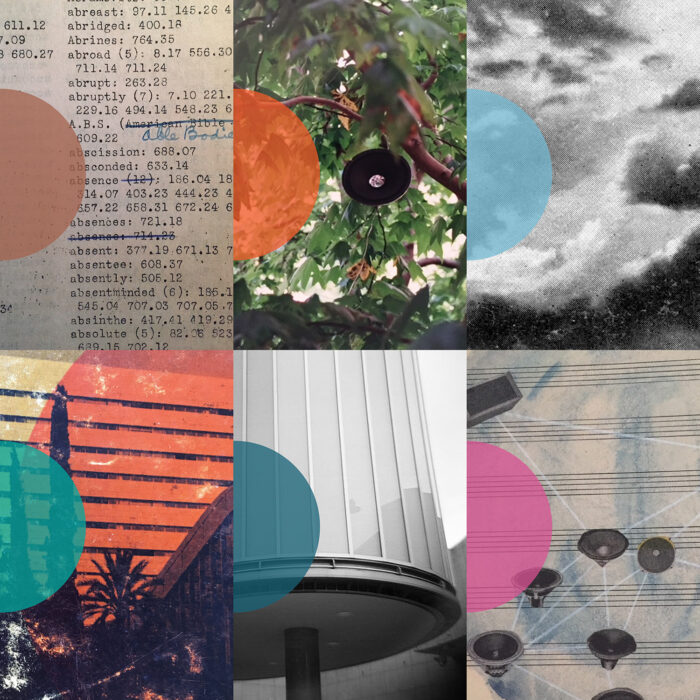
Special thanks to LINE for issuing six sound installations. I’m grateful to Richard for giving them this opportunity to reach a wider audience since sound installations are ephemeral. This release is especially timely for me as this September 6th marks the second anniversary of Steve’s passing… Sankaiki in Japanese culture. —Sari, 2025
remastered in 2025 by Taylor Deupree at 12k Mastering
original photography / art by Steve Roden
design by Richard Chartier
play at low volume
——————————
reading/without / reading/within (1999)
pencil on paper wrapped over wood blocks, sound composition, audio gear
Podewil / Berlin, Germany / 1999
the guardshack / Bergamot Station / Santa Monica, CA / 2000
the piece was inspired by hearing a recording of James Joyce reading/speaking a fragment of Finnegan’s Wake. the sound was composed using fragments of Joyce’s voice that were edited, looped and electronically transformed (via guitar pedals and other analog electronics). while the soundscape was made up of audible words, the processing allowed the words to disintegrate into a kind of pure sound or sound beyond words (and voice). the idea was to imbue an already difficult to understand text to unfold into pure abstraction.
the drawings were also made in relation to Finnegan’s Wake, generally conversing with a specific characteristic of a page in an attempt to make a drawing for every page of the book (which i did not complete). basically a drawing would be made based on an agreement with a page—such as drawing circles on the paper in relation to the placement of every letter “O” was found on the page, or tracing the shapes of the paragraphs, or reading a page out loud while making a continuous mark/line on the paper.
it was an early approach to working with texts as scores, and trying to allow a source to ignite a kind of rigorous play (which seemed quite relevant to the text…)
“while Joyce’s voice is the prominent voice, there is also some guitar, pedals, and electronics. the idea was to work with the voice until it broke down (going from audible words to noise). this was an early attempt to work with sound and words.”
— Steve Roden
MORE INFO / IMAGES
——————————
first bird form (2001)
40 speaker installation with sound
Snapshot: New Art from Los Angeles / UCLA Hammer Museum / Los Angeles, CA / 2001
Miami Museum of Contemporary Art / Miami, Florida / 2001
the piece was initially inspired by the trees in the center courtyard of the Hammer Museum, and i wanted to create a piece for the trees that had a similar presence to birds landing and wandering around all the branches. the installation involved 8 tracks of audio spread out over 40 small speakers placed on various branches. the source materials were acoustic recordings of dried leaves and twigs, as well as some early 78 rpm recordings of bird songs. all sounds were manipulated and transformed electronically via analog guitar pedals and electronics. the piece was intended to converse with the somewhat fractured nature of the trees in the middle of a very unnatural landscape. these images are from this initial installation at the hammer, and in miami the piece was installed in front of the museum, along a long concrete walkway, suggestive of audio ghosts of the original landscape.
“i sited my piece around a large atrium, with the hope that the electronic birds and the living birds will become friends”
— Steve Roden
MORE INFO / IMAGES
——————————
music for clouds (2002)
stereo composition, speakers and electronics, plywood structure, handmade pillow
e/static gallery / Torino, Italy / 2002
i wanted to create a viewing space with sound for the movement of clouds as they moved through a very beautiful skylight in the gallery space. the installation consisted of an elevated platform with small speakers. the idea was that one could lay down on the platform and watch the clouds move, while listening to the sound.
the audio was created using a score process i had been working for several years using the term ‘cloud formations’ to determine notes based on the contours drawn by copying the cloud’s shapes. it was a simple way of determining pitches based on the up and down contours. this idea began mainly as a path of singing notes moving up and down and trying to use form to determine “moves”. in this case i transformed the drawing of a cloud to the neck of an electric guitar and recorded various notes that followed the cloud path image. the work was played very softly through two speakers facing each other so that was only audible when one was laying down on the platform facing the skylight, head between the little speakers.
“this piece was certainly influenced inspired by eno’s ‘ambient’ and ‘generative’ recordings.”
—Steve Roden
MORE INFO / IMAGES
——————————
usonian poem (2004)
stereo sound installation
Frank Lloyd Wrights’s Hollyhock House / Barnsdall Art Park / Los Angeles, CA
commissioned for the event ‘Pleasure Garden’
my decision to work with Wright’s Hollyhock House began a few months earlier, in Japan. i visited a house designed by Wright in Kobe, and while exploring one of the terraces an acorn fell on my head. i picked it up and put it in my pocket.
when i was invited to create an installation for the event, i not only wanted to create a work in conversation with the Hollyhock House, but to bring my recent experience with Wright’s work in Japan into the conversation.
when people speak of site specificity, in relation to sound, it is usually a somewhat straightforward connection between site and sound. for myself, i tend to shy away from clear or overly logical decisions, thus, there is always room for intuitive decisions that might not add up intellectually, but offer a feeling of trust in terms of “rightness”.
thus i composed the soundscape using a series of processed recordings of the kobe acorn falling onto the strings of my lap steel guitar—so that the recordings played in front of the house in hollywood would be sonically touched by the sound of an object from a space in Japan that Wright had visited. formally, the soundscape was emanating from two speakers at opposite ends of a covered walkway, creating a sonic atmosphere for the space.
while the first iteration of the piece was wholly focused on the two Wright locations, the second version, which was created for e/static gallery in Torino, Italy, included other elements and ideas—mainly the inclusion of language (visible on the walls), and ideas related to translation.
having trouble sleeping because of jetlag, i spent much of my first evening in Torino translating the names of Torino streets into english. since i don’t speak italian, i could only read the italian words out loud and then would come up with corollary word in english – so that Torino was transformed into “to rain on”… the entire list of words was penciled on the wall of the gallery, so that the sound piece and the writing/drawing became a kind of mash-up, where disparate things are pressed together, so that they begin to function more like a tug of war than an embrace.
of course, the making of the pieces and the ideas behind them followed a ridiculously idiosyncratic path moving locationally (from Japan to Los Angeles to Italy and finally to Pennsylvania); moving linguistically (by connecting words in different languages—and knowing one and not knowing the other); blending architecture, sound and words into a single work (embracing the hybrid, the cluster, the constellation and the mess); and jettisoning logic towards intuitive connections (without questioning whether or not anyone can unpack the ideas.)
through this alchemical combination of trust and wonder the translation of the word ‘torino’ went through various permutations, moving from Torino, to ‘to rain on’ to ‘falling water’ as if i’d always known that an acorn from Frank Lloyd Wright in Japan would lead me through language, drawing and sound towards a final place known as ‘falling water’, which would bring Wright, and me, back to the beginning…
MORE INFO / IMAGES
——————————
night ring (2006)
field recordings, tuning forks, violin (played by Jacob Danziger), tapping of benches. 5.1 speaker system.
Henry Museum / Seattle, WA / 2006
night ring was one of a two part sound installation including day ring for the Henry Museum’s James Turrell Skyspace Light Reign. This is the companion sound piece that played from dusk to dawn, discreetly drifting softly from the Skyspace.
“more than simply adding something to the space, i wanted to converse with it, and to possibly shift its use but also while allowing all of its own integrity to remain intact… overwhelmed with the situation, and struggling with an approach that would appeal to the site and my own practice, i happened upon a set of tuning forks—each one supposedly tuned to the orbit of a planet (yes, pluto was still a planet then!). i liked very much the idea of a viewer/listener looking up at the sky and listening – and all the time unknowingly that they were listening to a sound map of planetary orbits. i brought the tuning forks to musician jacob danziger and asked him to improvise with each of the resonant tones of each tuning fork. i then combined the sounds of the tuning forks, the violin, and the field recordings—some left as is, and some processed—to build the sound pieces.”
—Steve Roden
MORE INFO / IMAGES
——————————
when stars become words (2007)
guitar, harmonica, processing
Mercosur Biennial / Porto Allegre, Brazil / 2007
commissioned for the Mercosur Biennial, the piece consisted of two large sculptural structures with sound. the structures as well as the sound compositions were built through various translation systems related to a list of 50 star names published by the Adler Planetarium of Chicago in the early 1940’s.
i used the vowels of the star names to generate a series of parts that were pieced together to create the larger forms—13 towards the smaller structure, and 37 towards the larger. the painted areas were also also determined by the vowels in conjunction with Arthur Rimbaud’s color vowel equivalents. the sound compositions were created from scores using the visual forms of various southern hemisphere constellations that included the same 50 stars.
while there is a level of pre-determined rigidity to the scoring process, the building and composing was actually quite intuitive, the pre-determined and the intuited conversing at all times.
the entire score consisted of 12 drawings made with pencil, watercolor and collage on found musical notation paper. the images are based on maps of constellations from the southern hemisphere that include stars whose names were used to generate the sculptural forms.
scores were placed beneath the strings of an old zither, so that the constellation determined the strings to be plucked. harmonica drones were recorded into pro-tools and the soundwaves were then organized on the screen visually to replicate the constellation form, leading to chance interactions between drones in terms of time lengths and pitch.
this version was done with a guitar, while a second version used a piano, and a third, a hamonium.
originally recorded in mono, and converted to stereo.
MORE INFO / IMAGES 1
MORE INFO / IMAGES 2