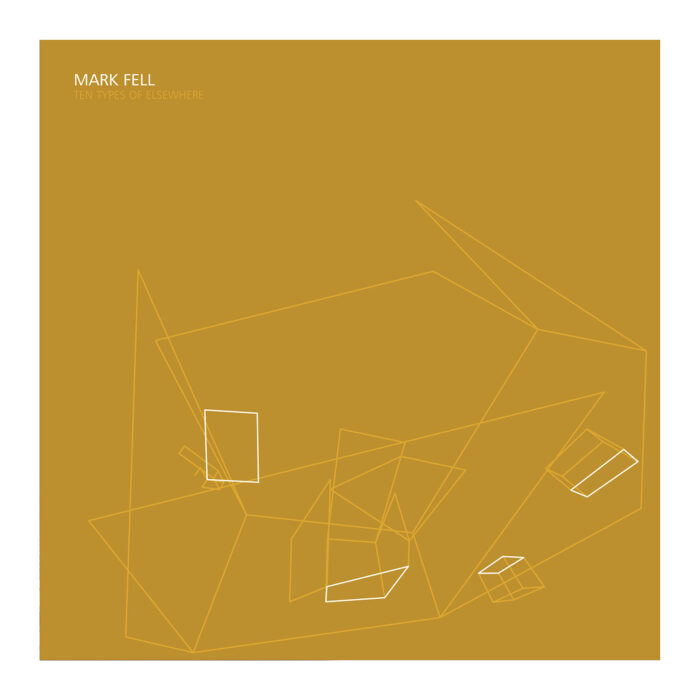
SPECIAL EDITION OF THIS LINE RELEASE OUT JANUARY 22, 2026
on Boomkat/LINE limited edition cassette — ORDER HERE
FROM BOOMKAT REISSUE PRESS RELEASE:
20+ year reissue of Mark Fell’s uniquely compelling debut solo album; a fascinating experimental playground for his ideas on topology, asymmetry, and spatiotemporal disruption, triggering one of modern electronic music’s most fanciful, radical, and peerless catalogues. Essential listening for anyone on the line from Autechre to Ikeda.
—
Topology is a branch of mathematics which explores both the actuality and the character of possible spaces, including what are thought to be limitless possibilities—spatial objects such as curves, surfaces, spaces outside our universe, knots, manifolds, phase spaces, symmetrical groups, etc. Topologists explore spatiality by asking questions about properties emerging through deformations such as twistings, rotatings, reflections and stretchings of objects: a circle is topologically equivalent to an ellipse (into which it can be deformed by stretching), by the same deformative principle a sphere is equivalent to an ellipsoid. Similarly, the set of all possible positions of the hands of a clock is topologically equivalent, AND the set of all possible positions of hours and minutes taken together are topologically equivalent. Spaces may be measured, scaled or be piled on top of one another.
One of the central ideas in topology is that spatial objects such as circles and spheres can be treated as objects in their own right, independent of how they are “represented” or “embedded” in space. Topological structures allow one to formalize concepts such as divergence, disconnectedness and discontinuity: generating spatialities by generating different rules about what will count as space. There is no particular limit to the possible rules that might be generated —what it is to be an object, the politics and distributions of the spatialities that go with objects, the interference making a difference to objectness, alterity, and the spatial limits of the conditions of possible objects. In topology there is a concern with spatiality, but in particular with the attributes of the spatial which secure continuity for objects as they are displaced through a space. The important point therefore is that spatiality is not given: it is not fixed, a part of the order of things, instead it comes in various divergent forms.
The making of objects indeed has spatial implications; spaces are not self-evident and singular, but are multiple, irregular, anomalous. Such spatialities (the objects which inhabit and perform them) are “unconformable,” they are other to one another. Objectness is a reflection and performance of that unconformity, the shift between different spatial im/possibilities. A performance of reality, that it makes present a representation of reality, and at the same time makes that reality. These various possibilities may be treated as an expression of spatial otherness, or more precisely as an expression of otherness combined with simultaneous and necessary spatial interference. This possibility of alternative spatialities is an essential move if we are to make a spatial link between objects and alterity, and to treat the alterity of objects in spatial terms. This new object we call objectile: the new status of the object no longer refers to its condition in a purely spatial mould (its relation to form/matter) but to its temporal modulation, implying the beginnings of a continuous variation of matter—a continuous development of form. The abject has only one quality of the object—that of being opposed to the I. It simultaneously “beseeches and pulverizes” the subject, experienced at its peak when that subject, weary of attempts to identify with something outside, finds the impossible within; when it finds that the impossible constitutes its very being, that it is one other than abject. The abject might then appear as the most fragile (from a syncronic point of view), the most archaic (from a diachronic one) sublimation of an object. The abject is that pseudo-object—the object of primal repression —the radically excluded that draws one toward the place where meaning collapses. It has to do with what disturbs identity, system, order—that which does not respect borders, positions, rules—the breakdown of the distinction between subject and object.
As topology encounters distortion with a certain inevitability, so to is their mirror between the object encountering the abject—the “to me—to you” dynamic. The inevitability draws one in, a deterministic mentality of “non-slackening,” from the forces on a shape-space to the character role in ‘protecting’ the network. Distortion of the physical shape and metaphysical ‘object’ can now be seen as a process defined in itself, rather than a process pre-defined as completing a transition between two states or points. As the process defined in itself becomes revealed, so too does the
idea of the uncertainty of destination, and a belief about incompleteness.
Incompleteness in this context suggests that within any given branch of mathematics, there would always be some propositions that couldn’t be proven either true or false using the rules and axioms of that mathematical branch itself. One might be able to prove every conceivable statement about numbers within a system by going outside the system in order to come up with new rules and axioms, but by doing so one creates a larger system with its own unprovable statements. The implication is that all logical systems of any complexity are, by definition, incomplete; each of them contains, at any given time, more true statements than it can possibly prove according to its own defining set of rules. Within a rigidly logical system propositions can be formulated that are undecidable or undemonstrable within the axioms of the system. That is, within the system, there exist certain clear-cut statements that can neither be proved nor disproved.
Transfinite numbers can be thought of as arising through counting. Imagine that you have a picture of yourself holding a picture. And that second picture is obtained by placing a copy of the first picture into each of the spaces between points in the first picture. The third picture is obtained by placing a copy of the second picture into each of the spaces between points in the first picture. The fourth picture is obtained by first continuing the process started in the first three pictures endlessly. In trying to think of more and more pictures in this series of pictures, one sinks into a kind of endless morass. Any procedure one adopts for understanding this process eventually becomes impossible, and one has a momentary glimpse of what the Absolute infinite is.
But imagine a mountain that is higher than infinity. This mountain consists of alternating cliffs and meadows. Even after one has climbed ten cliffs, a thousand cliffs, infinitely many cliffs, there are always more cliffs. Here the climbers are able to make some progress by executing a procedure called a “speed-up.” By using speed-ups they are able, for instance, to travel beyond the first infinity of cliffs in under two hours. The idea is to climb the first cliff in one hour, the next cliff in half an hour, the one after that in a quarter of an hour, and so on. Since 1 + 1/2 + 1/4 + 1/8 and so on never quite adds up to 2, we see that after two hours our climbers have passed infinitely many cliffs.
The Ten Thousand Buddha Temple is perched high on a hillside overlooking Sha Tin in the northern part of Hong Kong administrative region. To get here take the commuter train that runs through the New Territories, over the border to Shenzhen and into China. Beyond the town is a trail leading up the hillside. This is lined on each side with golden Buddha statues, each one with different characteristics encompassing every kind of human attribute. On top of this mountain are more statues now superhuman—one with incredibly long arms reaching into the sky, and another with long legs walking through a river and so on. Further still is a large hall thick with incense, around its walls are an infinite number of small Buddhas, each one dissimilar from the other in only one respect—an arm held vertically or horizontally, a hand held forwards or to the side—every possible permutation of the system. Like this temple the toyshops in Hong Kong are filled not with action men or similar singular-consolidated figures, but instead with sets and variations of identities—a repeated figure in a number of poses, a figure with a number of different versions of him or her self, a group of closely related figures.
Like the temple, if the self has an infinity of rooms, even after it fills up, more and more people can be squeezed in, without making anyone share a room. The most paradoxical thing about this scenario is that eventually we reach a limit to this wonderful system’s powers of absorption: alef-one (which is a hard number to describe). One way of putting it is that this is the first ordinal number such that no possible rearrangement can fit a set of a guests. Alef-one represents an order of infinity that is essentially greater. To get a better idea of alef-one, go back to the idea of a mountain as high as all the ordinals. How hard will it be for them to get to alef-one? These climbers could never reach alef-one. There is no way that they could fold together various finite bursts of speed and cover alef-one cliffs in a finite amount of time. The only way to get out to alef-one is by actually going ahead and travelling alef-one miles per hour.