Fill out the form below to receive the latest news about upcoming LINE editions and projects.

SIX MICROPHONES

Environmental Studies
Bandcamp Apple Music TIDAL Reviews
REVIEWS OF
Environmental Studies
  • Robert Gerard Pietrusko has long approached sound as if it were a form of urban planning: something to be mapped, shaped, and gently coerced into revealing its hidden structures. With Environmental Studies, though, he shifts from sculptor to ecologist. He doesn’t impose form—he invites it, then steps back to watch the environment negotiate with itself.

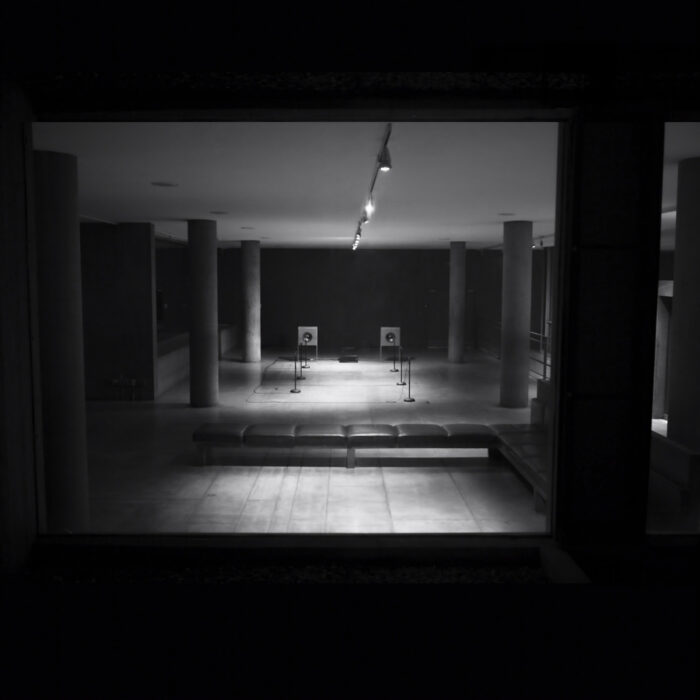
    The premise is almost disarmingly basic: a microphone pointed at a loudspeaker, a taut loop of attention between two devices that would normally behave themselves. But once this system is released into the Carpenter Center—the only North American building designed by Le Corbusier—the whole place starts behaving like a resonant organism. Concrete surfaces, circulation paths, gallery voids, the wandering public: everyone and everything becomes part of the instrument, whether they intended to or not.

    What’s striking is the absence of composed material. Nothing is written down, there is no “original” version hiding somewhere in Pietrusko’s notebook. All sound emerges from interaction: the system’s shifting parameters, the quirks of the architecture, and the fidgety presence of those who happen to pass through. It’s a bit like those conversations where you forget who started speaking – except the egos have been graciously removed from the equation.

    Across its three long sections, the album reveals an environment thinking out loud. Tones flutter like nervous eyelashes, drones bloom and collapse under the gallery’s geometry, and faint harmonic tensions drift around as if testing the limits of the room. Now and then a sudden shimmer or wobble appears – a reminder that Le Corbusier believed buildings should provoke, not simply behave.

    The irony is that this recording captures only one evening of a month-long installation in 2015. Yet the piece sidesteps nostalgia entirely: it belongs too deeply to the acoustics of its moment to sound dated. What you hear is not a fixed artwork but a trace of an encounter—an imprint of how space, system, and people briefly arranged themselves.

    Pietrusko, with his dual background in design and composition, continues to build bridges between disciplines that most artists keep in separate drawers. No wonder his work appears in major museums and biennales: he doesn’t so much compose music as create listening conditions, situations in which sound is coaxed into revealing its spatial DNA.

    Environmental Studies is a map without a key, an echo studying its own reflection, a quiet reminder of our scale. Sound doesn’t belong to us; it passes through, measures us, and moves on. If you let it, this album teaches you to follow it—not like a melody, but like a weather pattern.
    chaindlk.com

  • In 2019, US composer, academic and sound artist Robert Pietrusko released Six Microphones – both the title of the album and his moniker for the project – a “site-determined composition of audio feedback” taken from a 2013 installation at New York’s Storefront for Art and Architecture. Created via a series of mics and loudspeakers, Pietrusko allowed the feedback to be shaped by the space itself, the acoustic qualities of the room and the audience’s movement within it, not altering the resulting sounds with any additional sonic manipulation or embellishment.

    The project brings to mind Alvin Lucier’s I Am Sitting In A Room, in which a recording of the artist’s voice is gradually eroded by a process of playback and re-recording in a resonant space. If that piece conjures a particularly human melancholy, Pietrusko’s 2019 piece is contrastingly concrete and chilly, like moving slowly through abandoned, echoey buildings.

    On Environmental Studies, Pietrusko presents a triptych that’s not so much inhabited as haunted. Taken from the artist’s 2015 installation at the Cambridge, Massachusetts Carpenter Center for the Visual Arts (CCVA), it comprises three movements. “Environmental Studies I” opens with apparent caution, the slow quietness of his earlier work rising into occasional peaks of hard, reverberant unease, though this intensifies with “Environmental Studies II” and “III”, whose drones are joined by clashes and bangs, like doors being slammed in some unseen part of the building. Pietrusko’s methodology is intended to ensure variation between each performance, so that the movement of audience members or fluctuation in a microphone’s amplitude will cause spectral anomalies to loom up in the mixture.

    Environmental Studies feels unsettling, like being shown a photograph of some ghost captured drifting along a hallway, or hearing the startling voice of a spirit recorded in some apparently empty and quiet room.
    The Wire, UK

  • An excerpt from a gallery installation/performance from 2015, Philadelphia composer Robert Gerard Pietrusko’s Six Microphones is an exploration of space and frequency so pure that it’s almost breathtaking. The site-specific piece uses the half-dozen microphones of the title, directed at loudspeakers in order to create feedback. The score entails a manipulation of microphone amplitudes, in order to vary the sound of the feedback, but fluctuations are also triggered by the presence and movements of listeners within the gallery, as well as “the geometry and materiality” of the space itself. In the three-part, 45-minute recording, rich, warm tufts of drone billow and expand, clouds throwing off friction as they collide; every so often, a reverberant clang rings out deep in the mix, almost inaudibly. The microtonal play reminds me of Folke Rabe’s What?? or Kevin Drumm’s Imperial Horizon; a meditative exercise in the deepest of listening, it’s a stunning piece of drone music.
    Philip Sherburne / Futurism Restated

  • An interesting concept made real and surprisingly listenable: three different environments (rooms), and six microphones set up in each room. By raising and lowering the volumes of each of them individually, you get a drone that morphs and changes into different sonic areas creating different pieces each time. A wonderful headphone listen for a great sound experiment. I have heard this three times and I’ll be going back for more. The subtle changes make this so musical, even though no instruments were used. I really love this. It makes me want to experiment more with environments.
    citr.ca